
Energize Your Operations with NetSuite Cloud Intelligence.
NetSuite for Energy.
The energy industry demands precision, agility, and adaptability across its diverse segments, from exploration and production to renewable distribution. Beyond Cloud delivers NetSuite implementations tailored to meet these operational challenges, offering real-time financial and operational visibility.
We help energy businesses streamline workflows, manage assets, and maintain compliance in an ever-changing regulatory landscape.


Featured Clients:
Unified Operations Management
Gain real-time visibility across financials, supply chain, field operations, and maintenance—all in one place.
This centralized approach enables teams to make quicker, data-backed decisions and respond to market fluctuations with agility.
Asset & Equipment Lifecycle Tracking
Track and manage your assets from acquisition through decommissioning with full transparency.
Businesses can reduce downtime, improve maintenance planning, and extend asset lifespans through proactive insights.
Financial Consolidation & Compliance
Simplify complex consolidations and reporting for multi-entity or multinational energy operations.
With built-in governance, audit trails, and compliance tools, NetSuite ensures every number is accurate and every process is accountable.
Project Costing & Profitability
Monitor energy projects in real time to control costs, forecast profitability, and ensure resource efficiency.
These insights help teams prioritize initiatives and optimize capital deployment across divisions.
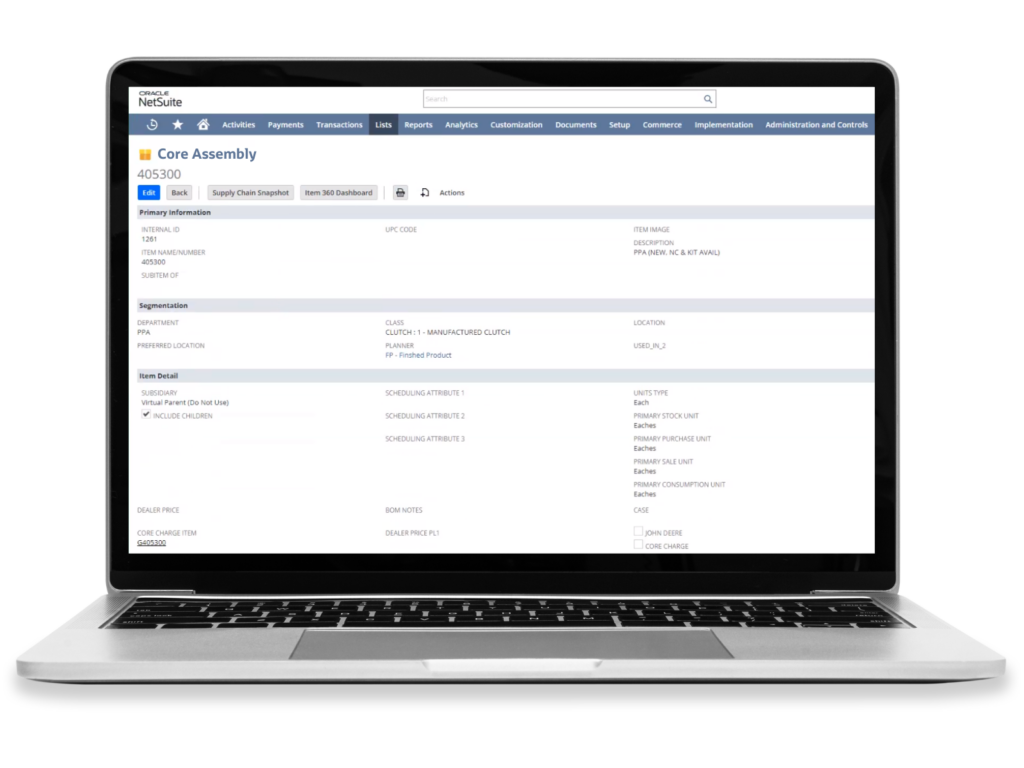
Solution Spotlight: Core Deposit Framework
Custom Solutions in the Energy Industry.
Our Core Deposits Framework simplifies and automates charge generation, core return management, and inventory tracking.
For energy companies managing large-scale equipment and parts, this ensures accurate core tracking, reduced manual errors, and improved financial reconciliation across complex operations.
How We Implement NetSuite for Energy
Every Beyond Cloud engagement follows a proven four-stage framework, tailored to the project, asset, and compliance demands of energy companies:
- Discovery & Blueprint — map your projects, assets, and compliance needs into a milestone-based plan.
- Configuration & Build — configure NetSuite for project accounting, fixed assets, and procurement.
- Data Migration & Testing — migrate projects, assets, and financials, then validate through structured testing.
- Go-Live & Enablement — launch, support cutover, and enable your team.
What Does NetSuite for Energy Cost?
There is no flat fee — your investment scales with scope. Most mid-market energy implementations range from the low tens of thousands of dollars for a focused rollout to several hundred thousand for complex, multi-entity or heavily customized projects, on top of annual NetSuite licensing.
The biggest cost drivers are your number of users and entities, the modules you deploy, integrations, data volume, and depth of customization. For a full breakdown, see our NetSuite implementation cost guide.
Hear From Our Past Clients!
Frequently Asked Questions
Does NetSuite support project accounting and job costing for energy?
Yes. NetSuite tracks project costs, budgets, and profitability across capital projects and field operations in real time.
Can NetSuite manage fixed assets and equipment?
Yes. NetSuite fixed asset management tracks equipment, depreciation, and maintenance across your operations.
Does NetSuite support multi-entity and compliance reporting?
Yes. NetSuite provides multi-subsidiary consolidation, multi-currency, and audit-ready reporting for complex energy operations.
How long does a NetSuite implementation take for an energy company?
Most run three to six months from kickoff to go-live, depending on complexity, integrations, and customization. Asset-management scope and field-service integration usually set the pace.
How much does NetSuite for energy cost?
It is scope-driven — typically from the low tens of thousands to several hundred thousand for implementation, plus annual licensing. In this sector, the big variables are asset-management scope, project accounting, and field-service integration. See our cost guide for the full breakdown.